

Author’s Note: I will continue releasing free content where I can provide value to everyone. Posts will include premium content for paid subscribers at the end of emails or as separate write-ups. Free content will focus on macro views, whereas the paid content will focus more on the tactical trades I’m making.
Serious traders or investors should join Premium to get the best, most timely information.
I have been digging into algorithmic trading for the last couple of months. With something like 70% of the trading activity in the US stock market being done by algorithm now, it’s essential to understand how the algos are ‘thinking.’
Firstly, algorithms define “factors” which are quantifiable characteristics of a stock. The factors can be broad, from something like “profitability” to “liquidity” to “momentum” to “distance from the 52-week low.”
Some algorithms are deterministic in that they are told exactly how to weigh and trade from these factors. Others are deep/machine learning algorithms, commonly known as “black boxes,” which are trained on a large (or small) number of these factors to pick stocks without explanation.
Let’s look at Bloomberg’s best and worst performing factors this year to understand what I mean.
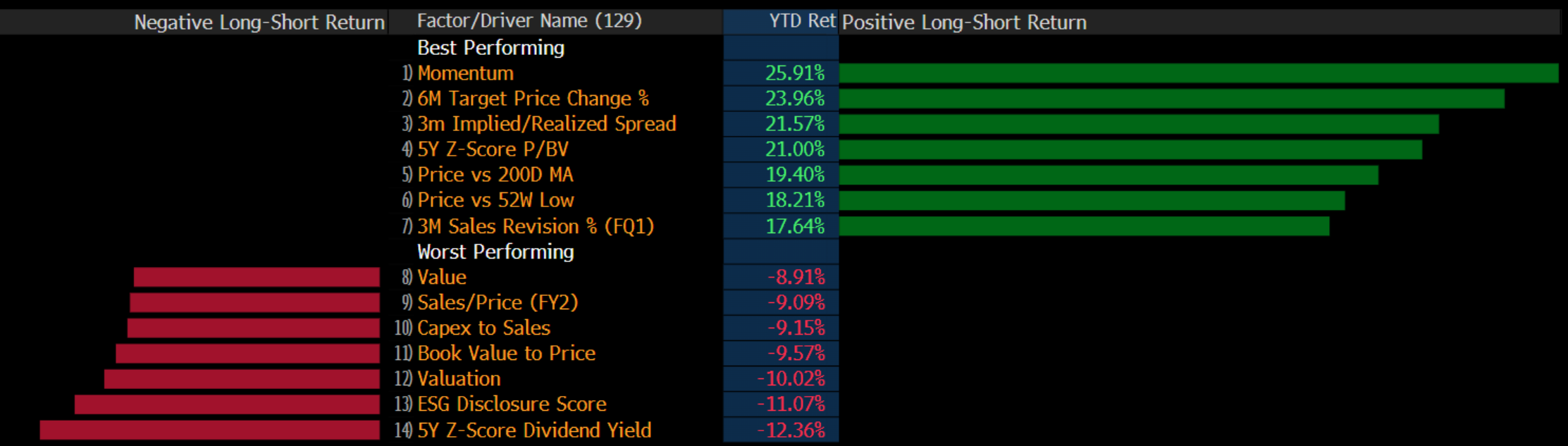
This chart shows the Long-Short performance of each factor, which is the YTD performance of longing the top segment of the factor (IE stocks with highest momentum) and shorting the bottom segment of the factor (IE stocks with lowest momentum).
Behind the scenes are countless machine/deep-learning algorithms creating long/short portfolios based on these.
Something like Momentum is a measure of the medium-term performance of a stock. With algorithms watching the momentum factor stocks that have done well in the last few months will tend to continue to do so, as algos will see that and get behind them.
Most factors are based on fundamental or technical analysis. I think it would be interesting to create a factor called “CNBC favorable mentions.”
Call it the Jim Cramer factor.

Let’s zoom in a little and look at the best and worst-performing factors over the last month.
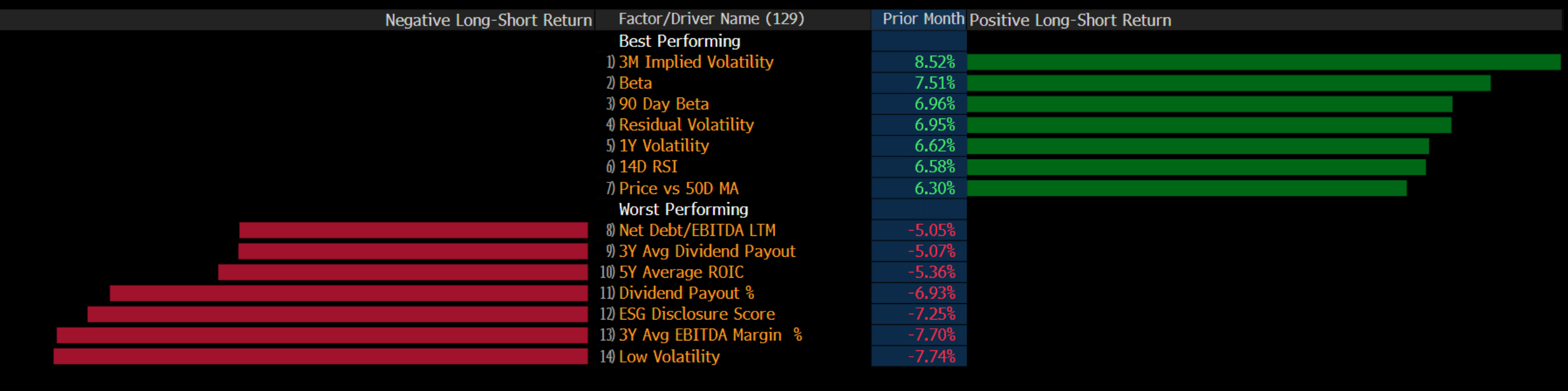
There isn’t a ton of overlap with the YTD factors, which is interesting. When you see the shorter time frame factor performances look significantly different from the longer-term time frame, that can represent a regime change.
Over the last month, it looks like highly volatile shit-cos with good technicals have outperformed.
There are no big surprises there, given the last month has been the bulk of the post-Trump euphoria.
Major Factors Post-Trump
I wanted to grab a few of the high-level factors and compare how they performed in the 6 weeks leading up to Trump’s win vs. how they performed after.
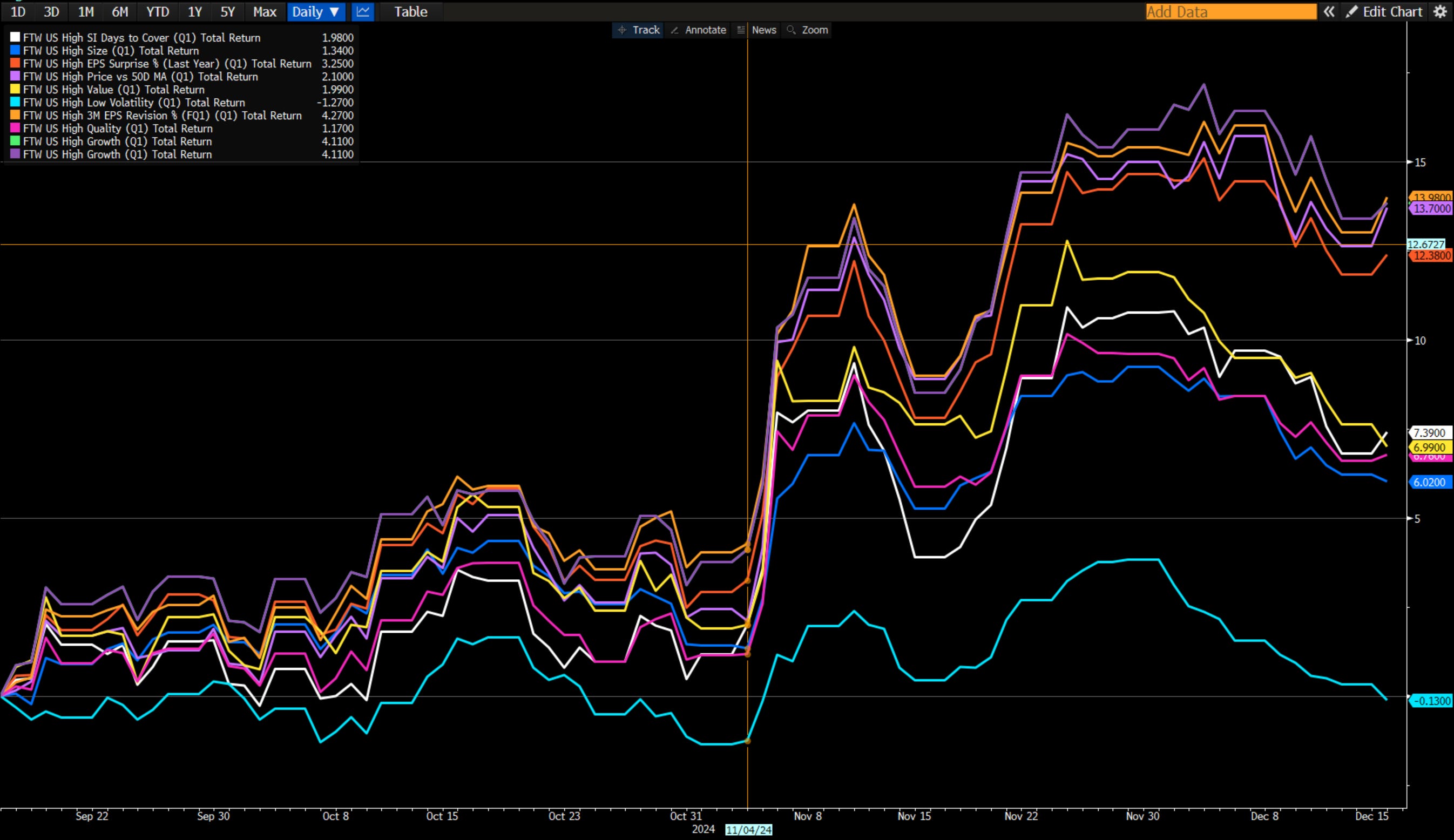
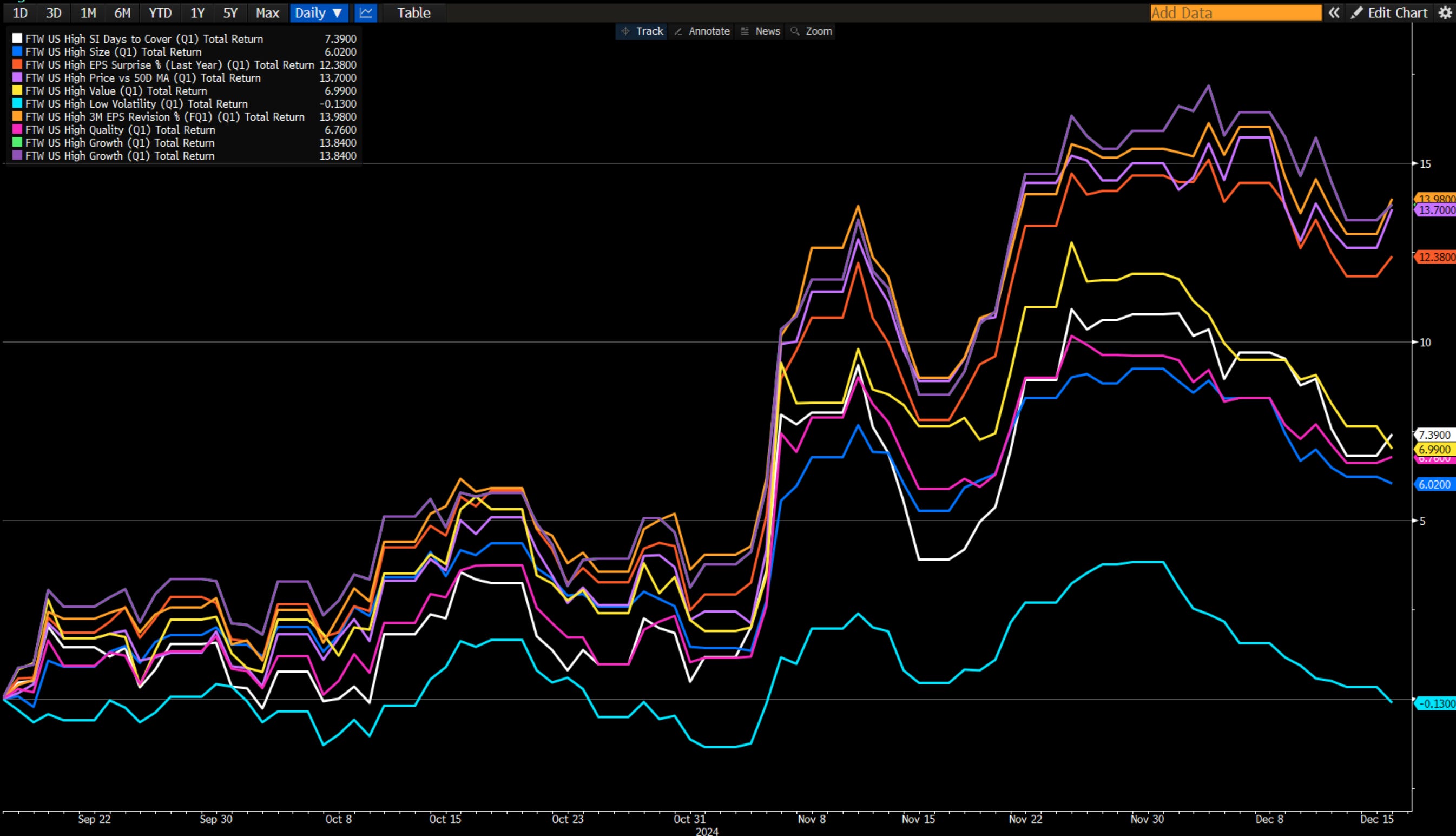
In the top left of each chart, you can see the returns by factor up to November 6th and December 16th, respectively. These are long-only returns, meaning these calculations have no bottom basket shorting.
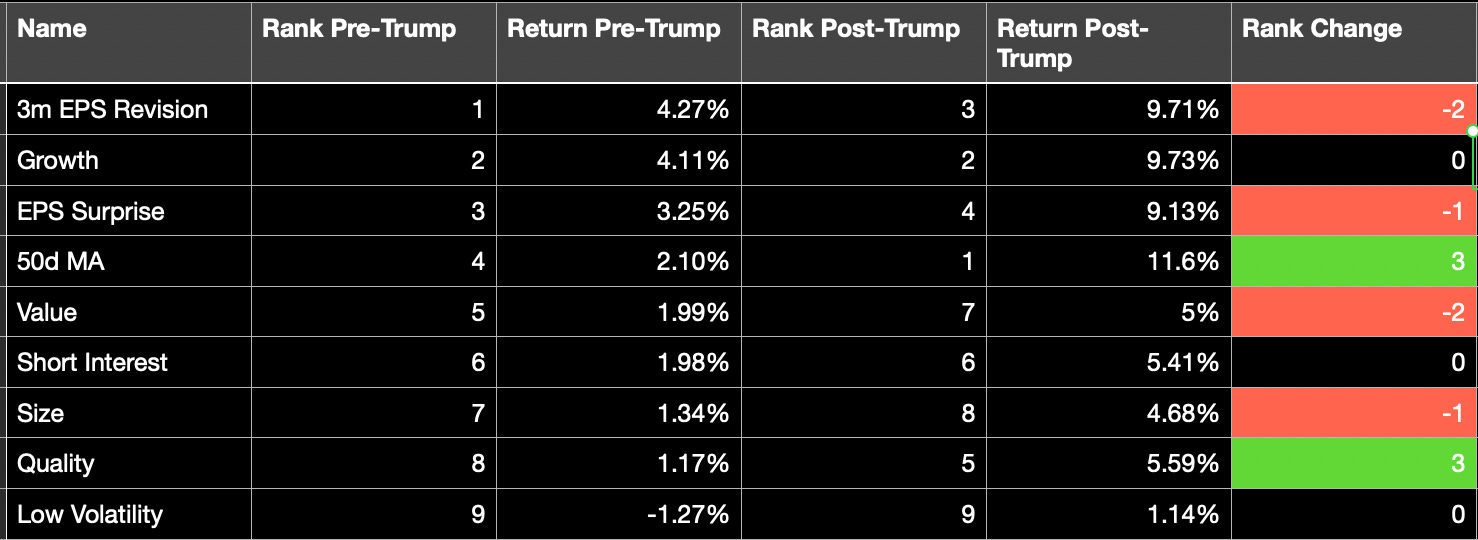
50d MA and Quality were the big winners of the election, with 50d MA leaping to the top performing factor post-Trump.
Interesting and not necessarily intuitive!
Quality is especially surprising, given that the 1mo, more nuanced factors seemed to say shit-cos were outperforming. But to be fair, Quality went from 8th to 5th. Not topping the charts.
Both EPS categories fell in rank post-election, along with Value and Size. I’m surprised to see that Short Interest wasn’t a higher-ranking factor post-election, but I suppose the market had largely priced in a Trump win.
Watching The Factors
I’ve been learning more about these factors and how they can be applied to algorithmic trading. I plan to start incorporating them more closely in my analysis going forward. I think this will be especially useful for you, the readers of Mind The Tape, who may not have access to a BBG terminal to check this stuff.
But I want to know what you think. Do you want more of this type of analysis? Do you want more macro takes?
Let me know in the comments.
Disclaimer: The information provided here is for general informational purposes only. It is not intended as financial advice. I am not a financial advisor, nor am I qualified to provide financial guidance. Please consult with a professional financial advisor before making any investment decisions. This content is shared from my personal perspective and experience only, and should not be considered professional financial investment advice. Make your own informed decisions and do not rely solely on the information presented here. The information is presented for educational reasons only. Investment positions listed in the newsletter may be exited or adjusted without notice.