

We’re coming out of one of the most violent semiconductor rallies in history, and everyone is wondering if semis are overbought. SOX is up 65% year-to-date, posted its longest winning streak in 32 years, and ran 47% in 18 trading days. Earnings season was extremely strong. And the bubble calls are getting louder by the day. Burry has loaded up on puts. Your favorite macro guy is saying markets have lost all touch with reality and we are at peak cycle hysteria…
They might be right, but they’re asking the wrong questions.
Whatever happens in the next two weeks or two months is a sideshow to what the advent of AI actually means for markets and the world. And what AI represents is the most important development in economics in 200 years.
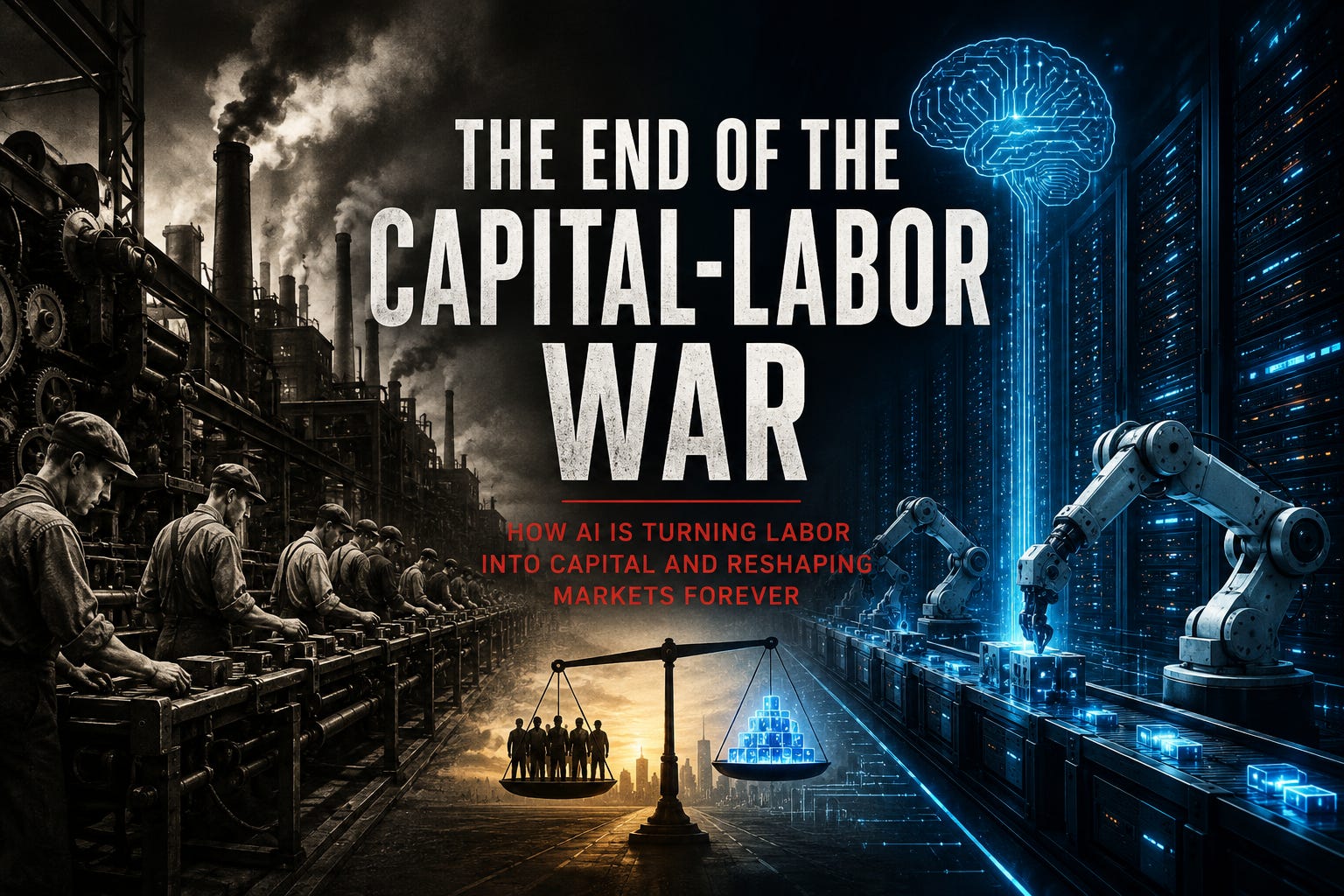
The war between capital and labor is ending. AI is what ends it. Labor is losing in a way it has never lost before and that stands to reshape markets and investing forever.
The Capital-Labor Cycle
The global economy is fundamentally a negotiation between two factors: Capital, which provides tools, land, and money, and Labor which provides time, effort, and skill.
Economic history is the drama of how the value they produce together gets divided.
For most of recorded history that negotiation was tilted one way or another, flipping back and forth with recent events.
After the Black Death wiped out a third of Europe’s population, labor briefly held all the cards. Peasants demanded wages, abandoned manors, and watched serfdom crumble. By the Gilded Age, capital had reclaimed the upper hand so thoroughly that a handful of industrialists had their own private armies. The postwar period swung the pendulum back: unions had teeth, real wages tracked productivity, and the median family could buy a house on a single income. Then around 1980 the pendulum reversed again, and we’ve been living in capital’s afternoon ever since, watching the labor share of GDP grind lower decade after decade.
This oscillation is a huge part of the historical debate between economists. Marxists, classical economists, and supply-siders disagree on almost everything, but they agree on the framing. Whether you read Ricardo, Piketty, or Friedman, you’re reading some variant of the same fight.
Marx had the most ambitious solution. His prescription was that labor would eventually seize the means of production and end the negotiation by abolishing one of the parties. The proletariat would own the tools it used. Game over, with labor on top forever.
But, that isn’t what happened. Marx assumed labor would always be necessary to operate capital, and the assumption held for the entire industrial revolution. Every wave of automation, from the spinning jenny to the industrial robot, displaced specific tasks while creating new ones, because a human was always needed somewhere in the loop. A weaver lost her job; a machine operator gained one. A bank teller was replaced by an ATM; a software engineer was hired to maintain the network. The aggregate share might shift at the margin, but labor stayed structurally indispensable. You needed humans to run the capital.
Every previous productivity revolution was therefore, at best, only a partial victory for capital. A reallocation, not a routing.
AI is something different.
The Truth About AI
Most people think of AI as just another technology, similar to the steam engine, electricity, and the internet as a general purpose technology, with the familiar pattern repeating: workers displaced, workers retrained, prosperity rises, the system absorbs the shock.
This view misses an important difference about AI.
Every prior automation wave automated specific muscle movements, motions, or calculations. It substituted for the body and for the most mechanical parts of the mind. The seat of judgment, taste, synthesis, language, and reasoning remained the exclusive property of humans, and as the lower rungs of the cognitive ladder got automated away, humans simply moved up the ladder.
AI is aimed squarely at replacing all rungs of the ladder, but especially the ones that automation has never touched before. The diagnosis. The strategic call. The judgment that used to belong to a senior partner. The synthesis that justified the corner office.
There’s an obvious objection here. Every previous technological revolution also obsoleted whole job categories, and every revolution created new ones to absorb the displaced. The steam engine didn’t envision software engineers. The internet didn’t envision prompt engineers. Why should this time be any different?
The difference this time is specifically how general the automation will be. Artificial General Intelligence seeks to replace humans across all applications. New jobs required new skills, but those skills lived inside human heads, and the heads were previously the bottleneck.
And don’t assume physical labor is the refuge. Robotics has been “five years away” for decades because the bottleneck was never the hardware. It was the brain. Perception, planning, dexterity, the judgment to handle the long tail of edge cases every real-world job throws at a worker. That’s what has held up the physical-labor automation wave for half a century, not the cost of servos or the precision of actuators (and to the extent the servos and actuators have been a problem, artificial design systems can solve that too).
The skyrocketing capability of AI is that brain. Whether general-purpose humanoids arrive in three years or ten, they arrive. And well before then, narrow systems will eat specific physical jobs the same way they’ve started eating specific cognitive ones. The carpenter and the programmer face the same problem on different timelines.
Once the substitute for human cognition becomes a line item on a capex budget, the structure of the labor market will change. In equilibrium, wages equal the marginal product of labor. Introduce a substitute whose capability rises every year and whose unit economics are dominated by capex (chip fabs, data centers, training runs), and the marginal product of human labor for any given task collapses toward the marginal cost of the substitute. The wage collapses with it, task by task and role by role.
Labor stops being a separate factor of production and starts becoming a particular form of capital, machinery you can buy by the GPU-hour. The negotiation between capital and labor doesn’t shift. It dissolves.
This is the prediction Marx couldn’t see, because he couldn’t conceive of capital that didn’t need labor to animate it. His theory of value rested on labor as the thing that made capital productive. Remove that premise, not just at the assembly line but at the cognitive level, and his framework still applies, but only to a world that no longer exists.
Where Marx Was Right
Marx was wrong about the path, but he was actually kind of right about the ending.
He predicted a world where scarcity was “solved” by humanity. Humans would be freed from work because the machines did everything. He thought labor would inherit this paradise by seizing the machines, creating a socialist utopia.
Instead, capital is seizing labor and creating a capitalist utopia.
The central political and economic question of the coming decades won’t be how to divide output between capital and labor. That question is closing. The new question is which capital will have the most leverage, and what to do with the people who used to be the other half of the equation.
Investing For The Future
If you’re reading this newsletter you’re probably less interested in the political philosophy and more interested in what to own.
The answer follows directly. If labor’s share is going to compress and capital’s share is going to expand, the natural place to look is at capital that produces the substitute for labor. Right now, that capital is accruing in three places:
Compute owners (hyperscalers). The handful of companies operating the data centers where the substitute actually runs.
Hardware providers. The picks-and-shovels layer: chips, memory, interconnect, packaging, the equipment makers behind them.
Frontier labs. The model builders themselves, where the cognitive substitute is being created.
But the point is not just to rehash the obvious “own AI” trade and move on.
The point is that if AI turns cognition into capital, then the companies that own the capital layer are not just participating in the next tech cycle. They are becoming the new claims on the future income stream of the economy.
That is the real reason the AI trade is so strange. On normal cyclical metrics, a lot of this looks insane. The stocks have run too far. The earnings revisions are too aggressive. The capex numbers are too large. The narratives are too clean. All of that may be true.
But if the underlying shift is real, then the market is not just paying for another semiconductor cycle. It is paying for a world where more and more of what used to be paid out as wages gets redirected toward compute, chips, memory, power, models, and distribution.
That does not mean every AI stock is a buy. It does not mean valuation no longer matters. It does not mean there won’t be brutal drawdowns, failed projects, overbuilt capacity, or periods where the whole thing looks ridiculous.
But it does mean the right question is not simply whether semis are overbought.
The right question is whether the market is beginning to price the capitalization of labor.
If it is, then the imperative is clear: focus on the assets that make labor less necessary. The companies manufacturing the hardware bottlenecks. The infrastructure builders. The companies that turn human judgment into a software expense and human output into a compute workload.
Marx thought labor would seize the means of production.
Instead, capital is building the means of replacing labor.
That is the final triumph of capital.
And that is the real AI trade.
Disclaimer: The information provided here is for general informational purposes only. It is not intended as financial advice, and is not a recommendation or offer to buy any securities. I am not a financial advisor, nor am I qualified to provide financial guidance. Please consult with a professional financial advisor before making any investment decisions. This content is shared from my personal perspective and experience only, and should not be considered professional financial investment advice. Make your own informed decisions and do not rely solely on the information presented here. The information is presented for educational reasons only. Investment positions listed in the newsletter may be exited or adjusted without notice.
Great article man, actually interesting which is rare to find
Subscribed, would love to have you along too🙂🙌